

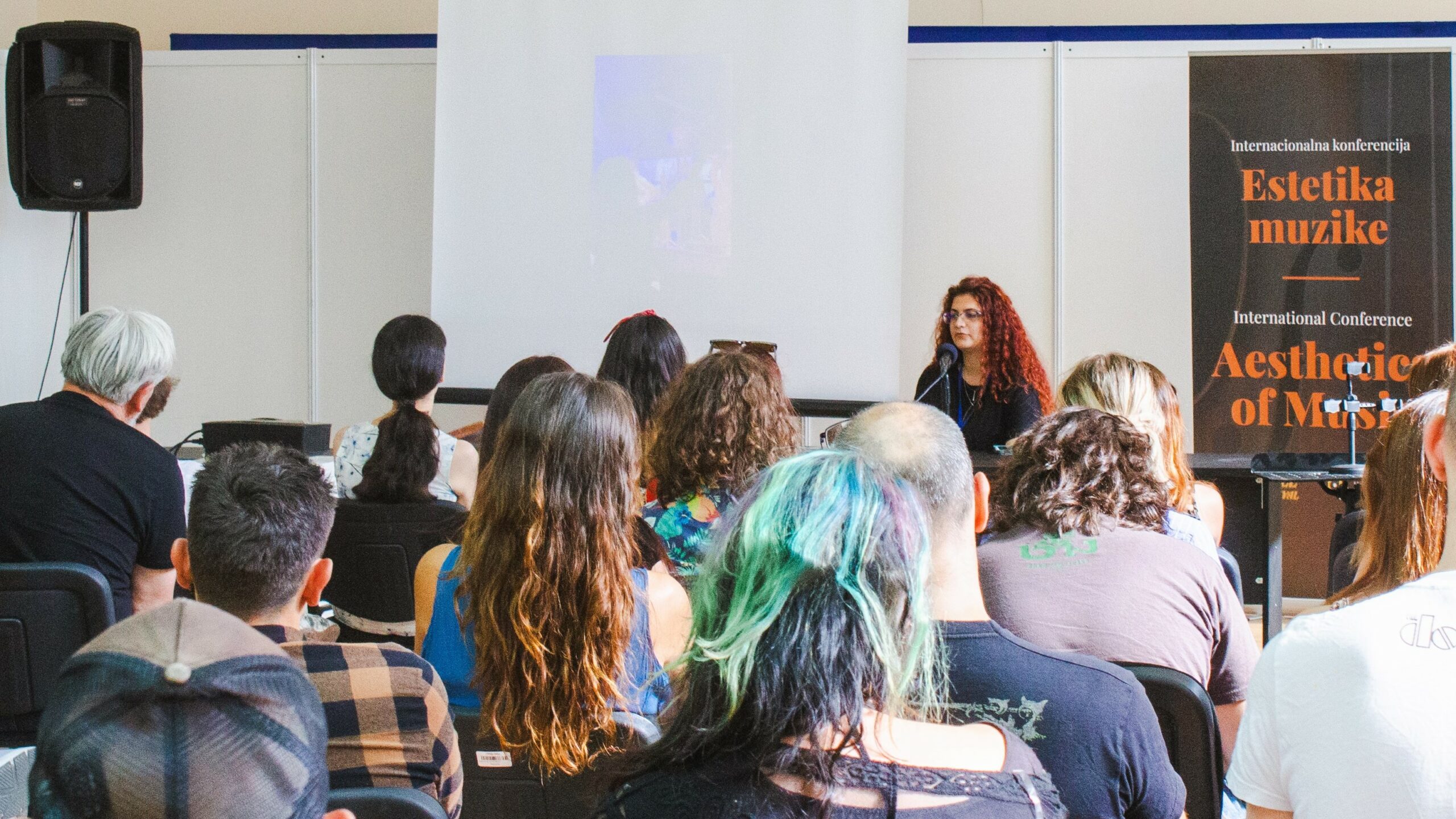
Internacionalna konferencija „Estetika muzike“ održaće se po četvrti put od 14. do 16. avgusta u zgradi Univerziteta u Nišu (Sala broj 8). Ovaj interdisciplinarni skup okupiće istraživače muzike različitih usmerenja – od filozofa muzike do profesionalnih muzičara – iz Poljske, Austrije, Rumunije, Malte, Italije, Severne Makedonije i Srbije.
Na ovogodišnjem izdanju skupa, osam istraživača će predstaviti svoja istraživanja u izlaganjima na engleskom jeziku koja traju 30 minuta. „Estetika muzike“ 2026 biće u znaku teorijskog promišljanja džeza i improvizacije, ali će se izlagači pozabaviti i temama iz istorije muzike, filozofskim i lingvističkim pristupom muzici, kao i ulogom muzike u filozofskoj praksi.
Urednik programa konferencije je Dušan Milenković, docent na Filozofskom fakultetu u Nišu i jedan od osnivača Evropske mreže za filozofiju muzike (ENPM). Skup organizuje Klub „Prejaka reč“ u saradnji sa Nišville fondacijom, a partner ovogodišnjeg skupa je i Centar za kognitivne nauke Univerziteta u Nišu.
Više o prethodnim izdanjima konferencije možete saznati ovde:
https://klubprejakarec.com/aesthetics-of-music
U nastavku objave, upoznajte se sa programom skupa i ovogodišnjim izlagačima.
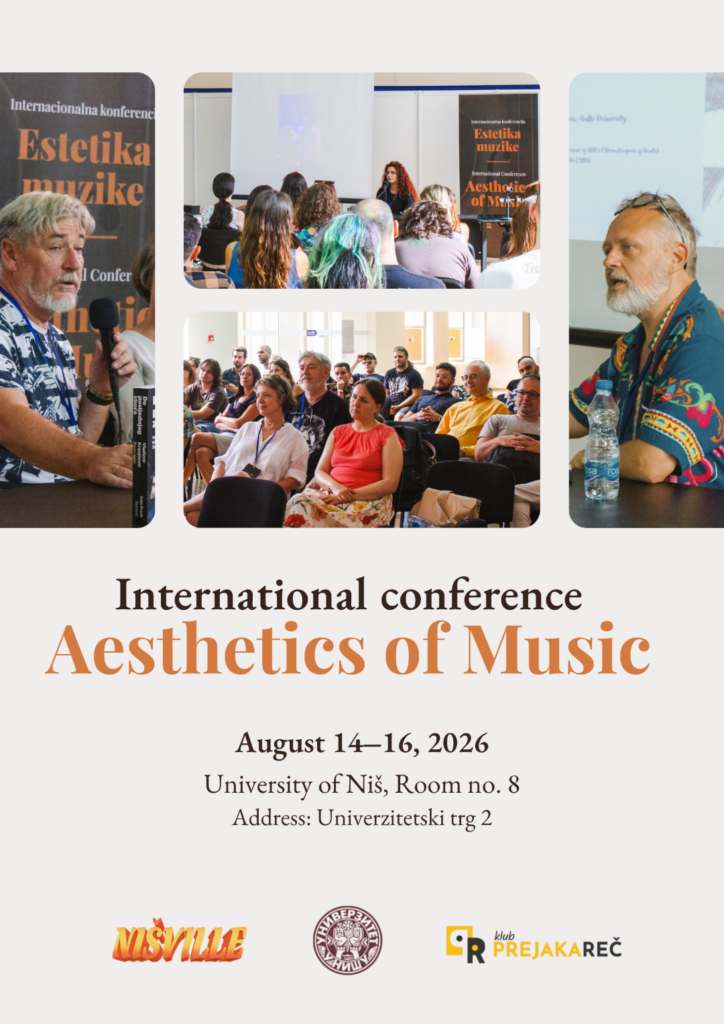
Program skupa:
Friday, 14.08.
15:45 – 16:00 Conference Opening
16:00 – 16:30 Alessandro Bertinetto (Italy) – The Role of Habits in Musical Improvisation
Discussion (20 min)
17:00 – 17:30 Sašo Popovski (North Macedonia) – North Macedonian Jazz Export – dream or reality?
Discussion (20 min)
18:00 – 18:30 Ivar Roban Križić (Austria) – ESP Duos – Imagined Co-Presence in Remote Improvisation
Discussion (20 min)
Saturday, 15.08.
16:00 – 16:30 Anna Chęćka (Poland) – Sum, Ergo Cogito: Music, Aisthesis, and the Embodied Self
Discussion (20 min)
17:00 – 17:30 Jeremy Coleman (Malta) – George A. P. Bridgtower and ‘The Old Humbug’: Towards a History of Historical Revival
Discussion (20 min)
18:00 – 18:30 Virgil Mihaiu (Romania) – The Fascinating Diversity of Europe’s Jazz
Discussion (20 min)
Sunday, 16.08.
16:00 – 16:30 Mihailo Antović (Serbia) – Musical Meaning is Real: Beethoven’s Sonatas and Texts about Them Share Underlying Schematic Structure
Discussion (20 min)
17:00 – 17:30 Nikola Ačanski (Serbia) – Music in Philosophical Practice: Current State and Future Perspectives
Discussion (20 min)
General Discussion
Upoznajte izlagače:
Alessandro Bertinetto is a Full Professor of Aesthetics at the University of Turin, where he also teaches Philosophy of Music. He has previously held positions as a Researcher in Aesthetics at the University of Udine, Associate Professor of Theoretical Philosophy at the University of Turin, and Alexander von Humboldt Fellow at the Freie Universität Berlin. He has been a visiting scholar at numerous institutions, including the Complutense and the Autonoma Universities of Madrid and the universities of Toulouse, Luxembourg, Kanazawa, Belo Horizonte. His research interests include aesthetics, hermeneutics, German idealism, philosophy of music, creativity, and improvisation. Among his published works are Il pensiero dei suoni (2012), Eseguire l’inatteso (2016), Aesthetics of Improvisation (2022), The Routledge Handbook of Philosophy and Improvisation in the Arts (ed. with M. Ruta, 2022), Estetica (2025), Filosofia della musica (2026), Infinite Form. On Andrea Gotti’s Painting (with S. Furlani, 2026). Currently, he focuses on the role of habits in aesthetic experiences and artistic practices. He is Chair of the Philosophy Degree Program of the University of Turin, the Director of the ART – Aesthetics Research Torino center (www.art.unito.it), and PI of the Project HABITUS-Habits, Aesthetic Behavior, and Improvisation: Theories, Uses, Studies of the Italian Science Fund.
Sašo Popovski is a Macedonian jazz guitarist and composer known for blending Balkan soul, Eastern melodic traditions, and contemporary jazz. With a signature style that’s both lyrical and exploratory, his music bridges introspection and rhythmic vitality. Popovski has performed across Europe—from Skopje Jazz Festival to Budapest Jazz Club—and collaborates with musicians across borders. He is a professor in the Jazz Department at Goce Delčev University in Štip. Following his acclaimed debut Steps (2023) on the French label Art Melodies, Popovski returns with Awakening (out August 12, 2025). More than just a title, Awakening reflects a year of movement, introspection, and personal transformation. Each composition tells a story—from the wintery stillness of 22 Days to Spring, to the surreal disorientation of Lost in Shanghai, and the lyrical tribute Dear Ron, honoring trumpet legend Ron Miles. Popovski’s sound is both grounded and expansive—modern, emotional, and deeply human. In 2021, the album Fallen Land finished first on the regional jazz scene of HRT Croatia’s Jazzolovka show and was the album of the week in Bulgaria, Serbia, Poland and Macedonia. Saso Popovski is member of Art Melodies composers society.
Ivar Roban Križić is a Vienna-based double bassist, composer, researcher, curator, and educator. He holds a master’s degree in jazz double bass and a doctorate in artistic research. His work focuses on musical improvisation, artistic research, and the relationship between performance, reflection, embodiment, and technology. Working across performance, composition, and research, he is particularly interested in how knowledge is produced through artistic practice and how improvisation can function as a mode of thinking, inquiry, and interaction. His recent work also engages with memory, difficulty, failure, documentation, and human–machine collaboration. He teaches artistic research at the University of Music and Performing Arts Vienna and is active internationally as a performer and researcher in the fields of improvised and experimental music.
Anna Chęćka is a philosopher, associate professor at the Institute of Philosophy, University of Gdańsk and Head of the Department of Aesthetics and Philosophy of Culture. She completed piano her studies at the Academy of Music in Gdansk and in Paris on a French government scholarship. In 2005 she completed her Ph.D. studies in philosophy (Dissertation: On criticizing music. Metacritical aspects of musical performance’s evaluations). In 2014, she gained her Habitation in philosophy. Anna has published four books in Polish: Critical Dissonances. Evaluating Performances of Musical Work, Gdansk 2008; Ear and Mind. Sketches of Musical Experience, Gdansk 2012; A as in Apollo: A Biography of Alfred Cortot, Warsaw 2019; Ear for Metaphysics, Warsaw 2020 (English version: Metaphysical Hearing, Warsaw 2021). She has also translated into Polish, Julian Johnson’s Out of Time. Music and the Making of Modernity for PWM publishing house (2026). Anna combines humanistic study with the view inspired by neuroaesthetics and neurobiology. In 2021 she co-edited a special neuroaesthetics issue of the Polish Journal of Art and Philosophy (Sztuka i Filozofia, 56/2020) and published several papers about music and the brain in collaboration with her Neurobiology Study Group. In 2025, she published The Musical Connectome: Essays in Bioaesthetics with Academicon. This book is also available in open access: https://omp.academicon.pl/wa/catalog/view/94/243/529
Jeremy Coleman (PhD) is Senior Lecturer in the Department of Music Studies, School of Performing Arts, University of Malta, having moved to Malta in 2020 to take up a full-time position. Originally from UK, he is a musicologist and collaborative pianist with interests in the 19th century as well as in interdisciplinary performance practices. His first book is Richard Wagner in Paris: Translation, Identity, Modernity (Boydell Press, 2019) and he has published articles and reviews on various topics in journals including Music & Letters, The Chopin Review and Current Musicology.
Virgil Mihaiu (born on June 28, 1951, in Cluj, Romania) is a writer, jazzologist, and diplomat, professor of jazz aesthetics, with a PhD in American Studies, polyglot.Member of the Writers’ Union of Romania; member of the Jazz Critics Association in the United States (J.J.A.); editor with STEAUA, cultural monthly edited by Romania’s Writers’ Union since 1949; member of PEN Club Romania; founder of the “Jazz Aesthetics” course at the National Music Academy in Cluj; member of the Down Beat Jazz Critics Poll global jury; honorary member of the Czech–Romanian Cultural Association in Prague; (since 2001) first Eastern European to join the editorial board of the world’s leading jazz magazine, Down Beat, published in Chicago; member of the F. Scott Fitzgerald Society, New York.Co-founder and director of the Romanian Cultural Institute in Lisbon and counsellor minister at the Romanian Embassy in Portugal (2006-2012); director of the Brazilian Cultural Center Casa do Brasil, under the auspices of UBB, Cluj-Napoca’s main University (since 2015). Author of over 20 volumes of poetry and essays, jazz radio & TV programmes, performer of jazz-poetry, etc.
Mihailo Antović is Full Professor of Linguistics in the Department of English at the Faculty of Philosophy, University of Niš, Serbia, where he also directs the Center for Cognitive Sciences. He holds a secondary music education alongside his linguistics training, a combination that has shaped his research ever since. His work centers on music and semantics, developed most fully in Multilevel Grounding: A Theory of Musical Meaning (Routledge, 2022), which traces how musical signification builds from formal-perceptual structure through image-schematic, conceptual, and cultural layers. He has since tested this theory empirically through corpus studies of music and language, and extended it into new domains such as religious discourse and visual art, publishing in journals including Cognitive Semiotics, Music Perception, Musicae Scientiae, and Frontiers in Psychology, and contributing chapters to volumes from Cambridge, Oxford, Brill, Springer, and John Benjamins. Antović has held fellowships from the Fulbright Program (Case Western Reserve University), the Alexander von Humboldt Foundation (Humboldt University Berlin, twice), and the Freiburg Institute for Advanced Studies, and has been appointed a Mercator scholar at Ruhr University Bochum’s Collaborative Research Center on Metaphors of Religion. He has delivered keynote lectures across Europe, from Gdansk and Bolzano to Barcelona and St. Petersburg.
Nikola Ačanski (b. 1993, Novi Sad, Serbia) is a PhD candidate in Philosophy at the Faculty of Philosophy, University of Belgrade. He completed his BA and MA in Philosophy at the University of Novi Sad, with part of his master’s research conducted at the University of Zagreb. His research interests include existential philosophy, philosophy of mind, philosophical practice, philosophy of music, psychoanalytic philosophy, and ideology critique. He is the founder of Filocentar (Centre for Education and Philosophical Practice), an initiative dedicated to making philosophy accessible through public lectures, workshops, philosophical counseling, and educational programs. His master’s thesis, The Nothingness of Consciousness: An Existential-Dialectical Approach to the Philosophy of Mind, received the Dr. Zoran Đinđić Award for the best master’s thesis in philosophy and sociology in Serbia. He has also received several literary awards for essays and short stories. Nikola has presented his research at several international conferences, including the 18th International Conference on Philosophical Practice (ICPP 2025), and has worked as a philosophy and logic teacher, university teaching assistant, translator, writer, and editor. His current research focuses on the ontological status of consciousness and the development of philosophical practice.